
Race Condition in Operating Systems: Understand It with a Simple Ticket Counter Analogy
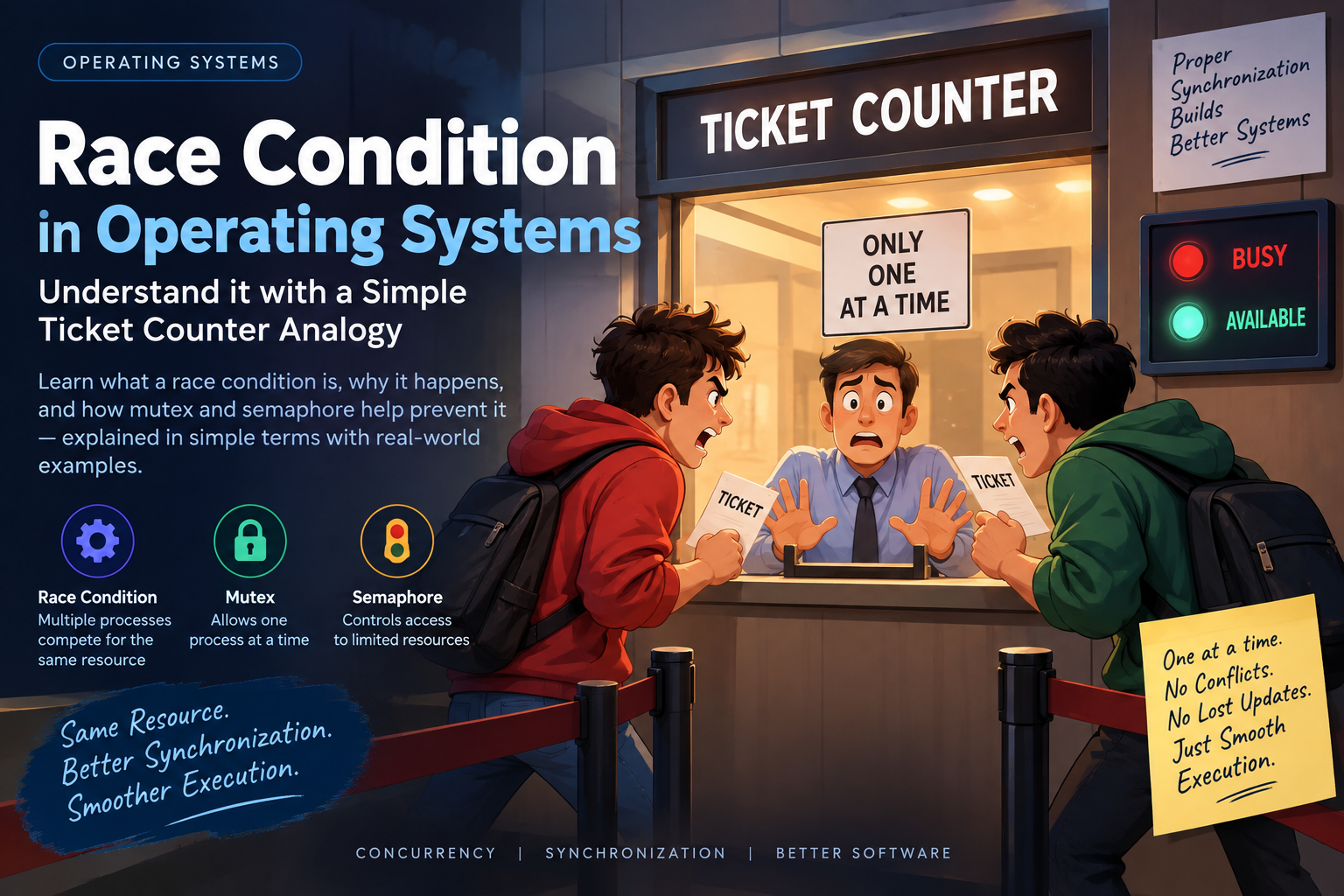
Imagine there is a ticket counter.
There is only one ticket window, and only one person can get a ticket at a time.
Now, two people suddenly reach the window at the same time.
Both are saying:
"Give me my ticket first!"
The ticket counter person is trying to handle both people at the same time. Both people want to use the same resource — the ticket counter.
This simple situation can help us understand one of the most important concepts in Operating Systems:
Race Condition.
What Is a Race Condition?
A Race Condition happens when two or more processes or threads try to access or modify the same shared resource at nearly the same time.
The final result may depend on which process runs first.
In simple words:
A race condition happens when multiple processes are racing to access the same shared resource, and the timing of their execution affects the final result.
Let's understand this using our ticket-counter example.
🎟️ The Ticket Counter Story
Suppose there is only one ticket left.
There are two people:
- Person A
- Person B
Both want the ticket.
The shared information is:
Tickets Available = 1
Now both people check the counter.
Person A thinks:
"There is one ticket available. I can take it."
At almost the same time, Person B also checks:
"There is one ticket available. I can take it."
Now we have a problem.
Both people saw the same shared information.
Both think the ticket is available for them.
But there is actually only one ticket.
This is the basic idea behind a race condition.
Why Does a Race Condition Happen?
Let's look at a simple sequence.
Suppose we have:
tickets = 1
And two processes:
Process A
Process B
Both processes want the ticket.
The execution might look like this:
Process A → Checks tickets → 1
Process B → Checks tickets → 1

Process A → Tries to take the ticket
Process B → Also tries to take the ticket
The problem is that both processes accessed the shared resource without properly coordinating with each other.
They are basically racing with each other.
That is why we call it a:
Race Condition
Another Example: Lost Update
Race conditions can also cause something called a Lost Update.
Suppose we have:
counter = 10
Two threads want to increase the counter by 1.
Normally, we expect:
10 + 1 + 1 = 12
But without proper synchronization, this can happen:
Thread A → Reads 10
Thread B → Reads 10

Thread A → Calculates 11
Thread B → Calculates 11

Thread A → Writes 11
Thread B → Writes 11
The final value becomes:
11
But we expected:
12
The update made by Thread A was effectively overwritten by Thread B.
This is a common example of what can happen because of a race condition.
The Real Problem Behind Race Conditions
The biggest problem with a race condition is that the program's behavior can depend on timing.
For example:
Run 1 → Correct result
Run 2 → Incorrect result
Run 3 → Correct result
Run 4 → Different result
Why can this happen?
Because the CPU scheduler decides when different processes and threads get CPU time.
Sometimes:
Process A runs first
Process B runs later
And sometimes:
Process B runs first
Process A runs later
Because the order can change, the final result can also change.
This makes race conditions difficult to reproduce and debug.
🏨 Think of It Like a Shared Resource
Let's connect our ticket counter to the Operating System.
The ticket counter represents a:
Shared Resource
The two people represent:
Person A → Process/Thread A
Person B → Process/Thread B
Both want access to the same resource.
Without any control:
Process A ───────┐
                 ├──→ Shared Resource
Process B ───────┘
Both may try to access it at the same time.
This is where synchronization becomes important.
We need some mechanism that says:
"Only one process can access this resource at a time."
🔐 Solution: Synchronization
Let's put a security system in front of our ticket window.
The rule is simple:
Person A → Enter
Person A → Get ticket
Person A → Leave

Person B → Wait

Person A → Finishes
Person B → Enter
Person B → Get ticket
Person B → Leave
Now both people cannot use the ticket window at the same time.
This basic idea is called Mutual Exclusion.
And this is where a Mutex comes in.
🔒 Mutex: The Lock on the Ticket Window
Imagine that we put a lock on the ticket window.
When Person A enters:
Mutex = LOCKED
This means:
"Someone is already using the ticket window. Nobody else can enter."
Person B arrives.
The system tells Person B:
"The window is busy. Please wait."
Person A gets the ticket and leaves.
Now the lock is released:
Mutex = UNLOCKED
Person B can now enter.
So the basic flow is:
Process A
    ↓
Acquire Mutex
    ↓
Critical Section
    ↓
Release Mutex
Then:
Process B
    ↓
Acquire Mutex
    ↓
Critical Section
    ↓
Release Mutex
Only one process can enter the protected section at a time.
🔒 What Does a Mutex Do?
Mutex stands for Mutual Exclusion.
Its main purpose is to make sure that only one thread or process can enter a protected section at a time.
If one thread is already inside:
Thread A → Critical Section
another thread has to wait:
Thread B → WAIT
A simple picture is:
             Mutex
               ↓
       ┌────────────────┐
A ────→│ Critical       │
       │ Section        │
B ────→│ WAIT           │
       └────────────────┘
When A finishes, B can get its turn.
🚦 Semaphore: Another Way to Control Access
Now let's understand Semaphore using the same ticket-counter idea.
Imagine there is a signal system in front of the ticket window.
Suppose:
Semaphore = 1
This means:
One slot is available.
Person A arrives and gets permission to use the resource.
The semaphore changes:
1 → 0
Now Person B arrives.
B sees:
Semaphore = 0
This means:
"There is no available slot right now. You have to wait."
After Person A finishes and leaves:
0 → 1
Now another process can use the resource.
Semaphore vs Mutex
Mutex and semaphore are both used for synchronization, but they are not exactly the same thing.
Mutex
Think of a mutex as the key to a room.
The person holding the key can enter.
Everyone else waits.
Its main purpose is:
Mutual Exclusion
One resource
     ↓
One owner at a time
Semaphore
Think of a semaphore as a counter for available slots.
For example:
Semaphore = 3
Conceptually, up to three accesses can be allowed at the same time.
When:
Semaphore = 0
there are no available slots, so new processes have to wait.
So a semaphore can be useful when you want to control access to a limited number of resources.
🎯 What Is a Critical Section?
Let's return to our ticket counter.
The actual work happening inside the ticket window is our Critical Section.
For example:
Check Ticket Availability
        ↓
Update Ticket Count
        ↓
Issue Ticket
        ↓
Finish
This part needs to be protected because it works with shared data.
A common pattern is:
Process A
    ↓
Acquire Lock
    ↓
Critical Section
    ↓
Release Lock
Then another process gets its turn.
⚠️ What Happens If There Is No Lock?
Let's go back to our ticket counter.
Two people arrive:
A                     B
│                     │
│ "I want a ticket"   │ "I want a ticket"
│                     │
└─────────┬───────────┘
          ↓
     Ticket Window
Both try to access the shared resource.
Without synchronization, the operations may happen like this:
A → Read
B → Read
A → Modify
B → Modify
Now the final result may not be what we expected.
The problem is not necessarily that the program is malicious or broken.
The problem is that:
Multiple actors accessed shared data without proper coordination.
💻 Real-World Examples of Race Conditions
Race conditions are not just theoretical Operating System concepts.
They can appear in real software systems too.
1. Bank Account
Suppose your account balance is:
₹10,000
Two transactions try to update the balance at almost the same time.
The system must properly synchronize these operations so that the final balance remains correct.
2. Ticket Booking
Imagine there is only one seat left.
Two users try to book that same seat at almost the same time.
The system must make sure that the seat changes safely from:
Available
to:
Booked
Only one booking should successfully claim the last seat.
3. Inventory System
Suppose an online store has:
Stock = 1
Two customers try to purchase the last item at the same time.
The system needs proper synchronization so that the same item is not assigned to two different orders.
4. Shared File
Two processes may try to modify the same file at the same time.
Without proper coordination, their operations can interfere with each other and potentially produce inconsistent or corrupted data.
🧠 How Can We Prevent Race Conditions?
Operating Systems and concurrent programs provide different synchronization mechanisms to control access to shared resources.
Some common mechanisms include:
- Mutex
- Semaphore
- Monitor
- Locks
- Atomic Operations
- Condition Variables
- Other synchronization primitives
The general goal is:
Make access to shared resources controlled and safe.
A simplified picture looks like this:
       Shared Resource
              ↑
              │
       Synchronization
              │
      ┌───────┴───────┐
      │               │
  Process A       Process B
      │               │
      └── Controlled ─┘
          Access
🏁 Final Takeaway
You don't need a complicated definition to understand a race condition.
Just remember the ticket counter.
There is one ticket window.
Two people arrive at the same time.
Both want the same ticket.
Both are trying to access the same shared resource.
If there is no proper synchronization, their operations can interfere with each other and produce an incorrect or unexpected result.
Now put a synchronization mechanism in front of the ticket window.
A Mutex says:
"Only one person can enter at a time."
A Semaphore says:
"Only as many people as there are available slots can enter. Everyone else must wait."
And the Critical Section is the part where the shared resource is actually being accessed or modified.
So remember the complete story:
Multiple Processes / Threads
            ↓
      Shared Resource
            ↓
     Concurrent Access
            ↓
       Race Condition
            ↓
       Synchronization
            ↓
      Mutex / Semaphore
            ↓
     Controlled Access
            ↓
      Safe Execution
A simple ticket counter can therefore help us understand a fundamental Operating System concept:
Race Condition is not really about two people fighting. It is about multiple processes or threads competing for shared resources without proper synchronization.
Once you understand that idea, concepts like Mutex, Semaphore, Critical Section, and Synchronization become much easier to understand.